The choreography of the mosquito
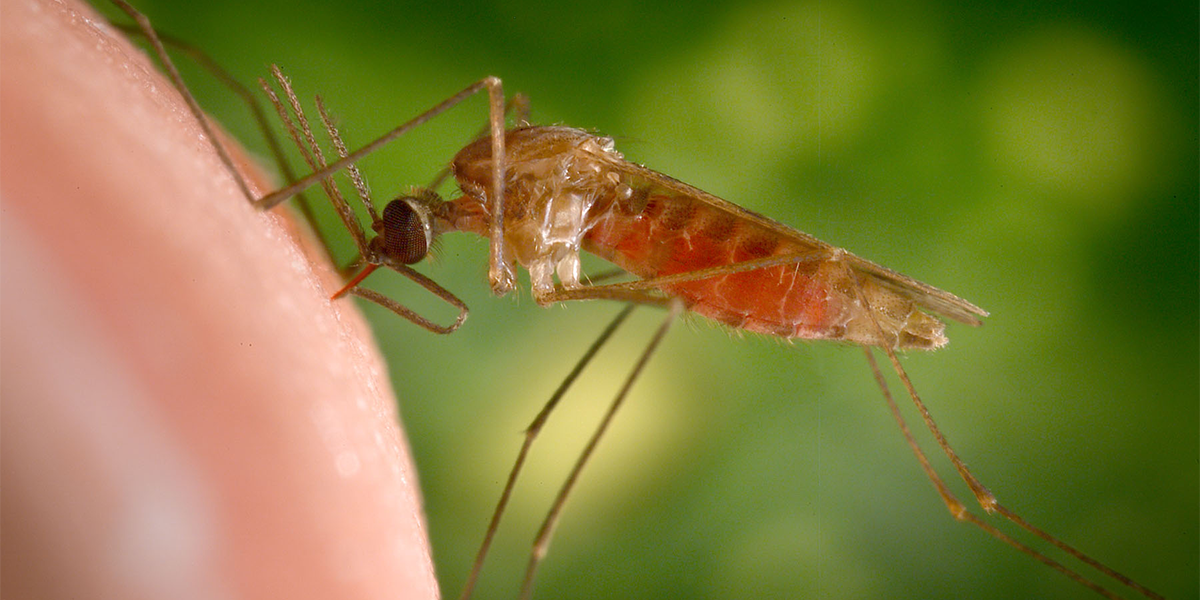
© A feeding female Anopheles gambiae mosquito (c) CDC/James Gathany, 2014
They bite and keep you awake with their irritating buzzing. I know, there are very few reasons to make an “elephant out of a mosquito”. Well, there are some, but they certainly don’t do the mosquito’s image any favours. A mosquito is no bigger than a breadcrumb – a tiny one at that – yet those three pairs of legs with wings keep you awake with ease. That in itself is quite a feat. Not one that inspires admiration, mind you, but still. Moreover, the impact of the mosquito extends far beyond that, unfortunately.
This article was translated from Dutch and originally published by EOS Wetenschap.
That tiny little creature that you can easily squish in the palm of your hand, sending it to mosquito heaven, is many times more horrific and deadly to humans than all elephants, lions, crocodiles, spiders, snakes and sharks put together. It is the deadliest animal in the world. As efficient spreaders of viruses and parasites, they are responsible for around a million deaths a year. Once again, a staggering ‘achievement’ for such a tiny creature, but not something to boast about.
When a male and a female synchronise their wing-beat frequency, and thus produce the same love song, they fly off together
The arguments in their favour are incredibly flimsy: mosquitoes are food for other animals, they pollinate plants and they make manufacturers of anti-mosquito products rich. That’s about it. And yet, even an animal with such an extraordinarily bad reputation has admirable qualities when viewed through the eyes of a biologist. One of these is the mosquito’s choreography. Male mosquitoes do not fight to win a mate; they dance, and the male who best synchronises his dance moves with those of a female wins.

Behavioural ecologist Sofia Vielma from the Institute of Tropical Medicine studies this spectacle using infrared cameras and 3D tracking. Vielma: ‘At dusk, the spectacle begins. Mosquitoes, such as the malaria mosquito, then gather above a spot that contrasts with their surroundings. This could be a patch of grass, but just as easily your dark head of hair. Scent, light and texture may all play a role in the choice of gathering place. Usually, a single mosquito sets the swarm in motion, after which other mosquitoes join in.’
The mosquitoes do not simply fly haphazardly about, but make characteristic loops. There really is order in the apparent chaos. ‘In such a swarm, a male flies back and forth in a semicircle. A female enters the swarm for about twenty seconds, chooses a male, and then they leave together. During this brief visit, the male rapidly adjusts his wingbeat speed to match that of the female. A mosquito’s wings form a sort of figure of eight, and this is how their buzzing sound is created. The faster they flap their wings, the higher the pitch. When a male and a female synchronise their wing-flapping frequency – and thus produce the same love song – they fly off together.’
This mosquito choreography may seem like a fun fact, but it can be a matter of life and death. Sofia Vielma studies the mosquito dance primarily because it may offer opportunities to combat the spread of deadly diseases. ‘After mosquitoes mate, the female needs a blood meal to produce her eggs. She then leaves the dance and flies in a straight line towards someone to bite. So the more mosquitoes that are dancing, the more females are out and about in search of blood and likely to bite people. In regions where mosquitoes spread life-threatening diseases, we could catch, scare away or control dancing mosquitoes with insecticides, meaning they would bite fewer people and thus spread fewer diseases.’
We might even be able to lure mosquitoes into a trap. ‘We need to investigate this further, but perhaps a sound recording of dancing females could attract the males. We could then disrupt the swarm, for example with insecticide.’
And so I find myself back in an anti-story again, even though that runs counter to the aim of this column. But however fascinating the mosquito’s love song may be, to us it sounds, above all, like a declaration of war.
Spread the word! Share this story on
More stories
-
 - Articles
Research that could not be allowed to fail
Selien Oostvogels and Christian Kahusu illustrate how research depends on teamwork and perseverance.Read more -
- Articles
Two ITM partner laboratories become new members of WHO's Supranational Reference Laboratory Network
SRL Kigali and SRL Maputo will strengthen the quality and capacity of tuberculosis laboratory services in sub-Saharan Africa.Read more -
- Articles
Three ITM junior researchers awarded PhD fellowships by the Research Foundation of Flanders
Olivia, Niels and Lies will carry out research on habitat restoration, post treatment recurrence in leprosy, and a potential leishmania vaccine.Read more -
- Articles
Hidden gaps, hidden costs: eight studies on outbreaks, care and resistance
With the Fresh Off The Journal series, we bring you our monthly research highlights.Read more -
- Articles
Dr Mamane Moussa Dan Baki elected as alumni representative to ITM's General Council
We are pleased to announce that Dr Mamane Moussa Dan Baki (Niger) is the new alumni representative in ITM's General Council for the 2026-2030 term.Read more -
- Articles
“Dare to ask questions: you will gain visibility”
As we near ITM's 66th Colloquium, postdoctoral researcher and Scientific Committee member Dr Thao-Thy Pham reflects on her work on leishmaniasis, her partnership with Ethiopian colleagues, and what she hopes Colloquium participants will take home.Read more -
- Articles
Final preparations underway for pivotal Phase 2/3 Bundibugyo vaccine trial
Tumaini, a pivotal Phase 2/3 clinical trial, will evaluate vaccine candidates including Ervebo as part of the DRC's outbreak response. There is currently no approved vaccine against Bundibugyo virus. Tumaini aims to close that gap.Read more -
- Articles
Who is at risk, and who is reached? Eight new insights into infection, care and prevention
With the Fresh Off The Journal series, we bring you our monthly research highlights.Read more -
- Articles
First 100 medical crisis intervention volunteers are undergoing training at ITM
One hundred volunteer doctors and nurses will form a Medical Reserve Unit (MRE) in Flanders that can be deployed rapidly in the event of acute, local health crises. They are gathering today for the first time for a training day on infectious diseases and outbreaks at the Institute of Tropical Medicine in Antwerp. They were welcomed by Caroline Gennez, the Flemish Minister for Welfare and Public Health, who will be providing 250,000 euros per year to the MRE over the next three years.Read more -
- Articles
How a nurse from Sierra Leone broadened her perspective at ITM
Introducing graduate Fatmata Bintu KargboRead more