Scales
Abstract
Health inequities often manifest in spatially patterned ways, and urban tuberculosis (TB) is a particularly suitable case study due to its high incidence, marked spatial heterogeneity, and strong links to local transmission dynamics. Recent advances in geographic information systems, increased availability of georeferenced data, and growing recognition of space as an active determinant of health have driven renewed interest in spatial epidemiology. This scoping review examines how these developments are reflected in epidemiological research practices, focusing on the spatial distribution of TB in urban settings.
Our objective is to explore which spatial scales have been used in the academic literature about tuberculosis in cities and assess which arguments the authors used to justify their choice of scale.
Products
-
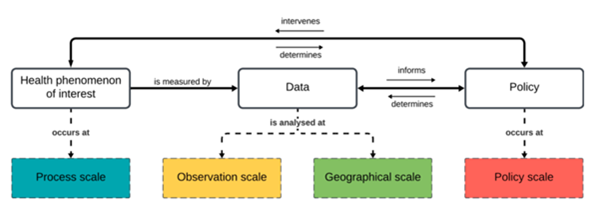
Framework on spatial scales and its relationship with health, health-related data, and policy