Ebola outbreak in the DRC and Uganda

Last updated: 17 May 2026
The World Health Organisation (WHO) has declared the Ebola outbreak in the Democratic Republic of the Congo (DRC) and Uganda a public health emergency of international concern. The outbreak is caused by the Bundibugyo virus, an Ebola virus for which there is currently no approved vaccine or treatment. The risk to the population in Belgium remains low.
Ebola is a deadly viral disease that can cause fever, severe fatigue, vomiting, diarrhoea and, in some cases, bleeding. The virus does not spread through the air, but through direct contact with the bodily fluids of an infected person or with contaminated materials.
An international public health emergency means that the WHO is calling on countries to be extra vigilant and to strengthen international cooperation. It does not mean that there is a pandemic.
Travellers can find information about risk areas, symptoms and prevention on Wanda, ITM’s travel medicine website.
Bundibugyo virus
This outbreak is caused by the Bundibugyo virus, one of the viruses that can cause Ebola. There are currently no approved vaccines or treatments for this Ebola variant.
ITM and INRB pool expertise
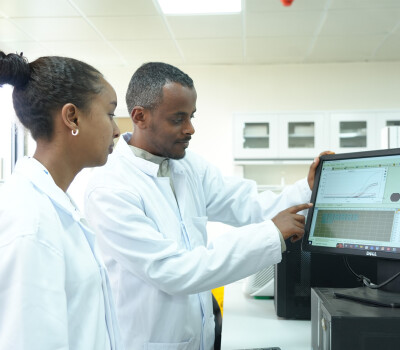
ITM is closely monitoring the Ebola outbreak in the DRC, in close collaboration with its long-standing partner, the Institut National de Recherche Biomédicale (INRB) in Kinshasa. Through ITM-DRC office, developments are monitored and activities coordinated with Congolese and international partners. At the request of and in consultation with INRB, ITM's expertise is being deployed in three areas: genetic analysis of the virus (sequencing), laboratory diagnostics and clinical research into potential treatments.
Tony Wawina from the Unit of Clinical Virology is on site in Kinshasa and, together with colleagues from the INRB, played a key role in sequencing the Bundibugyo virus. Koen Vercauteren from the Unit Clinical Virology is also travelling to Kinshasa to work with Placide Mbala of INRB to strengthen diagnostic capabilities with test kits.
Diagnostics is currently a major bottleneck. The rapid, fully automated PCR tests using GeneXpert do not detect this variant, meaning laboratories have to rely on other, more labour-intensive PCR tests. Kevin Ariën from ITM’s Unit of Virology and Daniel Mukadi from INRB are looking into how ITM can provide additional support in this regard.
Clinical research is also being prepared. Isabel Brosius from the Unit of Tropical Medicine and Laurens Liesenborghs from the Unit of Clinical Emerging Infectious Diseases are collaborating on the preparation of a WHO-led clinical trial into potential treatments.
Reliable updates
Spread the word! Share this story on
More stories
-
 - Articles
Final preparations underway for pivotal Phase 2/3 Bundibugyo vaccine trial
Tumaini, a pivotal Phase 2/3 clinical trial, will evaluate vaccine candidates including Ervebo as part of the DRC's outbreak response. There is currently no approved vaccine against Bundibugyo virus. Tumaini aims to close that gap.Read more -
- Articles
Who is at risk, and who is reached? Eight new insights into infection, care and prevention
With the Fresh Off The Journal series, we bring you our monthly research highlights.Read more -
- Articles
First 100 medical crisis intervention volunteers are undergoing training at ITM
One hundred volunteer doctors and nurses will form a Medical Reserve Unit (MRE) in Flanders that can be deployed rapidly in the event of acute, local health crises. They are gathering today for the first time for a training day on infectious diseases and outbreaks at the Institute of Tropical Medicine in Antwerp. They were welcomed by Caroline Gennez, the Flemish Minister for Welfare and Public Health, who will be providing 250,000 euros per year to the MRE over the next three years.Read more -
- Articles
How a nurse from Sierra Leone broadened her perspective at ITM
Introducing graduate Fatmata Bintu KargboRead more -
- Articles
Connecting research, policy and partnerships for better access to cancer medicines
Tinashe Zigomo, a PhD candidate at the University of the Western Cape School of Public Health, reflects on a four-week visiting scholar period at ITM Antwerp, focused on access to essential breast cancer medicines in low-resource settings.Read more -
- Articles
An infectious disease anywhere is an infectious disease everywhere
From the frontlines of the current Ebola outbreak in Central Africa to the resurgence of drug-resistant TB in Europe, weakening global health systems make all of us less safe.Read more -
- Articles
Infectious disease specialist Isabel Brosius wins Eos Pipet 2026 for her leadership in mpox research
The jury praises her strong scientific work and pronounced societal engagement.Read more -
- Articles
Strong collaboration strengthens the response: how jointly developed sequencing expertise helps to unravel the Bundibugyo Ebola outbreak
When the current Bundibugyo Ebola outbreak emerged in the Democratic Republic of Congo, researchers at ITM’s partner institute, Institut National de Recherche Biomédicale (INRB), responded immediately. ITM Professor Koen Vercauteren talks about the role of long-term investment in sequencing technologies and scientific partnerships.Read more -
- Articles
"This research will have a far greater impact on the people of Tanzania than the PhD degree I have earned."
An interview with Dr Amani Kikula, a researcher in obstetrics and gynaecology from Tanzania.Read more -
- Articles
"Infectious diseases cannot be studied from one discipline alone"
Ahead of the 66th ITM Colloquium, scientific leads Prof Dr Johan van Griensven from the Institute of Tropical Medicine (ITM) in Antwerp and Dr Endalamaw Gadisa from the Armauer Hansen Research Institute (AHRI) in Addis Ababa discuss why mobility is central to understanding infectious diseases and why researchers need to look beyond their own discipline.Read more